
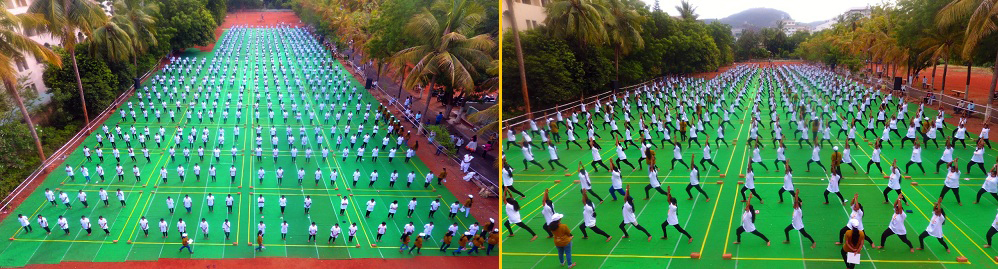
About Yoga
What is Yoga ? Yoga is a scientific system of physical and mental practices that originated in Our India more than thousands of years ago. Its purpose is to help each one of us achieve our highest potential and to experience enduring health harmony happiness and Healing. With Yoga, we can extend our healthy, productive years far beyond the accepted norm and, at the same time, improve the quality of our lives Rejuvenate your health, wealth at sacred space which is aimed at healing ,renewal and nourishment of the soul, body and mind Peace.
Hatha Yoga
When most of us in the west talk about yoga, we’re talking about Hatha yoga. ‘Hatha’ is the combination of two Sanskrit words: Ha, meaning Sun, and Tha, meaning moon. As a concept, Hatha represents the balance of opposites - hot and cold, fire and water, male and female, positive and negative. Similarly, Hatha yoga works to balance the energies of the mind with those of the body through physical exercises (asanas), controlled breathing and calming the mind with meditation and relaxation.
Astanga Yoga
Ashtanga is the original flow practice from India. The technique of vinyasa, linking the poses together in a flowing sequence of movements timed to breath, originates with Ashtanga Yoga. This vigorous and flowing practice focuses on a set, a progressive series of postures. This class is an accessible and condensed version of the Ashtanga Primary Series, focusing on breath and concentration to help calm your mind and strengthen your body
Kundalini Yoga
Kundalini Yoga as taught by Yogi Bhajan® is called the Yoga of Awareness. It is a dynamic, powerful tool that is designed to give you an experience of your soul.In Kundalini Yoga we harness the mental, physical, and nervous energies of the body and put them under the domain of the will, which is the instrument of the soul.
Nada Yoga
Naad Yoga is based on the experience of how sound vibrations affect the body, mind, and spirit through the movementof the tongue, the mouth, and changes in the chemicals in the brain. We can alter consciousness by changing the chemical composition of the fluids in the brain.
Vinyasa Yoga
The word “vinyasa” can be translated as “arranging something in a special way,” like yoga poses for example. In vinyasa yoga classes, students coordinate movement with breath to flow from one pose to the next. Ashtanga, Baptiste Yoga, Jivamukti, Power Yoga, and Prana Flow could all be considered vinyasa yoga. Vinyasa is also the term used to describe a specific sequence of poses (Chaturanga to Upward-Facing Dog to Downward-Facing Dog) commonly used throughout a vinyasa class.
Mantra YOGA
Mantra Yoga courses: Samrddi Mantra this is for who suffering with Depression, Stress, Anxiety, Fear etc. We give yoga therapy also. Advita Mantra is for all. It is art of living sessions. Anamda mantra it is Meditation corse for all ages. Arogya Mantra is Genral yoga we teach Asanas Pranayama Mudra Bandha etc.
Power Yoga
Power yoga is the modified form of Vinyasa-style.
This style of practice was originally closely modeled on the Ashtanga method, Yoga which is a scientific system of physical and mental practices that originated in India more than three thousand years ago.
Its purpose is to help each one of us achieve our highest potential and to experience enduring health and happiness.
With the emphasis of Power Yoga, we can extend our health to develop strength and stamina, and concentrate on weight loss at the same time we can improve the quality of our lives.
Power yoga is the modified form of Vinyasa-style this style of practice was originally closely modeled on the Ashtanga method. Yoga which is a scientific system of physical and mental practices that originated in India more than three thousand years ago. Its purpose is to help each one of us achieve our highest potential and to experience enduring health and happiness. With the emphasis of Power Yoga, we can extend our healthy develop strength and stamina, and concentrate on weight loss at the same time, improve the quality of our lives.
Pilates:
Power yoga is the modified form of Vinyasa-style.
Pilates is a form of exercise that focuses on using both the mind and body to achieve optimum performance.
The deep stabilizing muscles of the body are conditioned and strengthened using sequences of movements that use gravity, body weight and specially designed equipment as forms of resistance.
The connection between the mind and body is crucial to Pilates. Pilates trains the mind to maintain a constant level of awareness of the way the body moves. This results in a greater control of motion and vastly improved technique.
Aerial yoga
Power yoga is the modified form of Vinyasa-style.
In an aerial yoga class, you perform the same poses you do on a yoga mat, except you use a silk hammock that's suspended from the ceiling as a prop to support you through the various flows. The purpose of the hammock is to help you improve flexibility and build strength, while allowing you to do more challenging poses without added pressure on your shoulders, spine, or head.
Practicing yoga has long been considered one of the best ways to stay fit and release stress. While traditional yoga is great for the mind and body, Aerial yoga has a few additional benefits. We’ve recently rolled out new Aerial yoga classes at our Albany studio, and we encourage both newbies and longtime yogis to try this exciting new offering. Read on to learn more about what to expect at an Aerial yoga class, and the benefits that Aerial yoga can provide.
What is Aerial Yoga?
Aerial yoga, also referred to as anti-gravity yoga, shares a lot similarities with traditional yoga. However, there’s a big difference. When participating in aerial yoga classes, the weight of your body will be supported by a hammock. This means you’ll be suspended in the air! It’s a great option for beginners and experienced yoga performers.
What Are the Benefits of Aerial Yoga?
1. Great for Back Sufferers
While everyone can benefit from aerial yoga classes, they’re especially great for people experiencing back pain. Because of the hammock’s support, far less pressure is placed upon your joints. Aerial yoga also doesn’t strain the spine, which is a huge advantage for back pain sufferers. You’ll be able to obtain a full body workout without any discomfort.
2. Helps with Breathing
Controlled breathing is an important aspect of yoga. Aerial yoga allows you to breathe deeply with any restriction. While hanging in the air, you’ll be able to totally relax. Aerial yoga enables you to comfortably maintain every pose. Over time, you can even expect to improve your lung capacity.
3. Enhances Flexibility
In order to maintain a great range of motion, you must consistently work on your flexibility. Aerial yoga class will definitely help you to safely stretch your muscles and tendons. Being suspended in the air gives you more space to move. This means you’ll be able to perform yoga poses that you can’t do on the floor.
4. Stress Relief
Don’t underestimate the stress relief that stems from participating in aerial yoga classes. If you happen to be going through a rough time or experiencing anxiety attacks, aerial yoga will help put your mind at ease. It gives you an opportunity to meditate and focus on positive thoughts (while hanging upside-down!). Beyond just stress relief, the pros of being inverted include increased balance, more energy, and better focus. When you’re inverted, blood flows to your brain and provides oxygen it needs for brain function.